
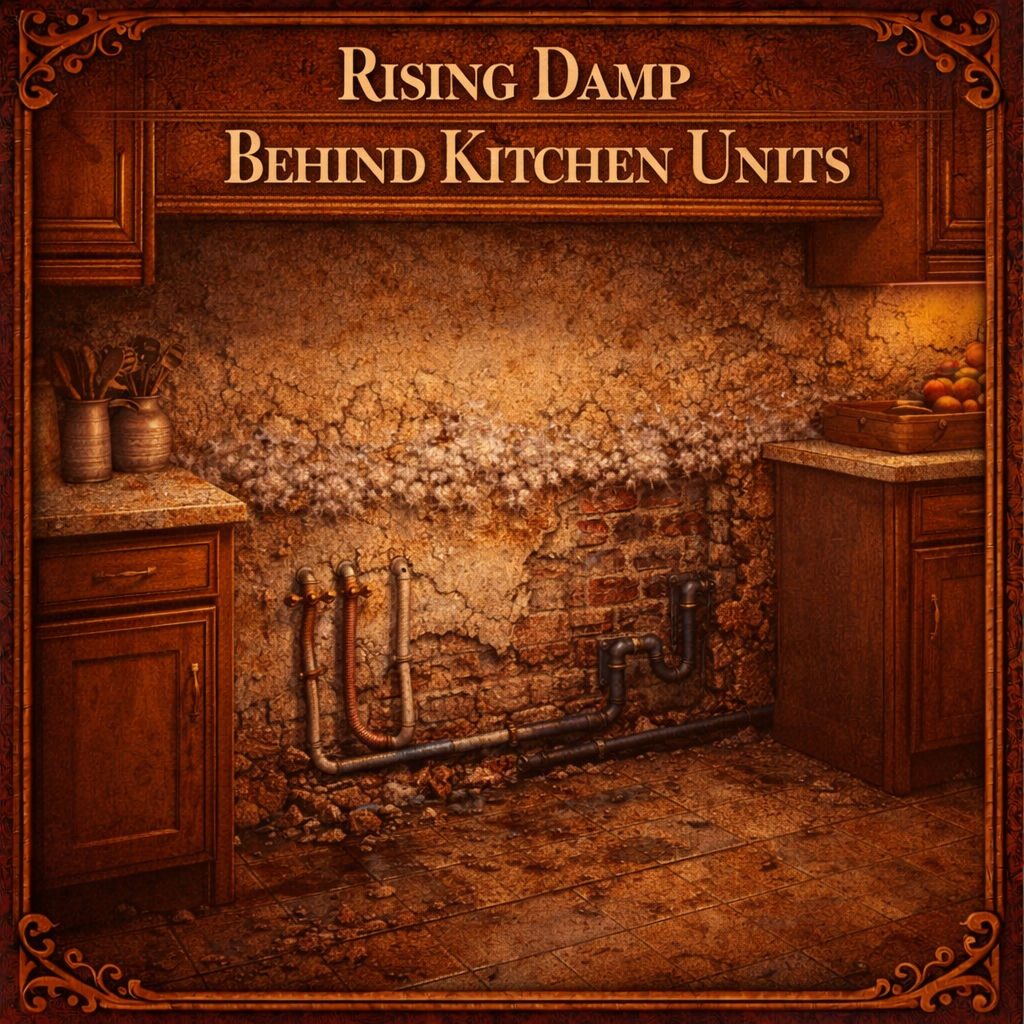
Rising damp behind kitchen units is a common but often overlooked issue in many homes. Because kitchen cabinets and fitted units conceal large sections of wall, moisture problems can develop unnoticed for long periods, leading to more extensive damage before they are discovered.
Unlike exposed walls, areas behind kitchen units have limited airflow. This lack of ventilation creates an ideal environment for moisture to accumulate and persist. When rising damp is present, the trapped moisture cannot evaporate effectively, which can accelerate the deterioration of both the wall and the units themselves.
One of the first signs of rising damp behind kitchen units is often a musty smell. Homeowners may notice an unpleasant odour in the kitchen but struggle to identify the source. In more advanced cases, signs may become visible around the edges of units, such as peeling paint, staining, or warped plinths.
If units are removed, the extent of the problem is usually much clearer. Common indicators include damp or crumbling plaster, salt deposits on the wall surface, and visible tide marks. Timber components of the kitchen, such as carcasses or kickboards, may also show signs of swelling, rot, or mould growth.
The underlying cause is typically the same as other forms of rising damp. Moisture from the ground rises through the wall due to a failed, missing, or bridged damp proof course (DPC). However, the presence of kitchen units makes the situation worse by preventing evaporation and hiding early warning signs.
Another contributing factor can be modern kitchen installations that are fitted tightly against walls with little or no gap for airflow. In some cases, impermeable materials such as vinyl coverings or foil-backed boards can trap moisture further, compounding the issue.
Addressing rising damp behind kitchen units requires a thorough approach. The first step is to remove the affected units to fully inspect the wall. Without doing this, it is impossible to assess the extent of the damage or carry out proper repairs.
Once exposed, the source of the damp must be resolved. This may involve installing or repairing a damp proof course, as well as checking for external issues such as high ground levels or poor drainage that could be contributing to moisture ingress.
Damaged plaster should be removed and replaced with a suitable, salt-resistant system. Simply drying out the wall and reinstalling units is not sufficient, as residual salts can continue to attract moisture and cause ongoing problems.
When refitting the kitchen, it is important to allow for some airflow behind units. Small gaps or ventilation provisions can help reduce the risk of moisture build-up in the future.
In summary, rising damp behind kitchen units is a hidden problem that can lead to significant damage if left untreated. Early investigation, proper damp proofing, and thoughtful installation practices are key to preventing recurrence and ensuring a long-lasting solution.
Leave a Reply