
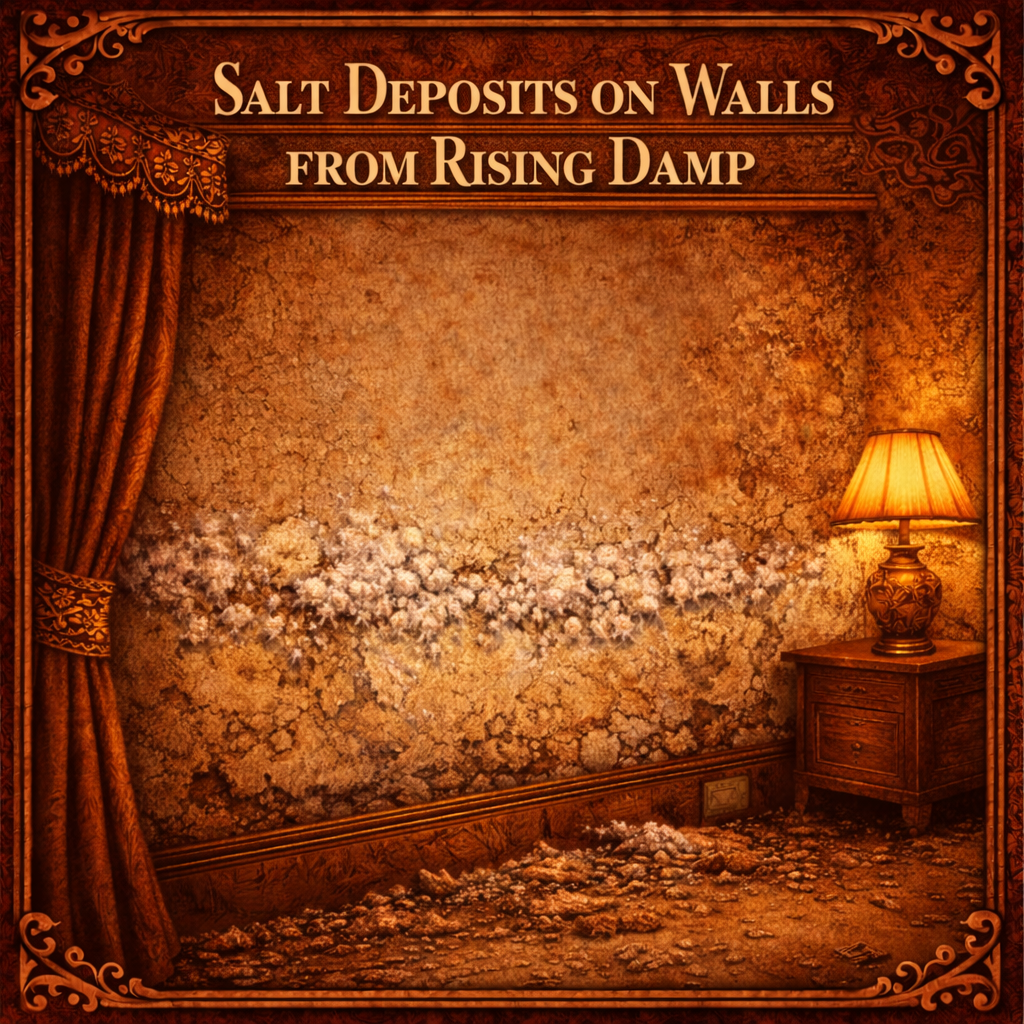
Salt deposits on internal walls are a common symptom of rising damp and often appear as white powdery crystals on plaster or brick surfaces. These deposits form when groundwater travels upward through masonry and carries dissolved salts from the soil and building materials.
As moisture rises through a wall, it contains various soluble salts such as nitrates, chlorides, and sulphates. These salts are naturally present in the ground and can also come from the bricks, mortar, or historic construction materials used in the building.
When the moisture reaches the internal surface of the wall, it begins to evaporate into the surrounding air. As the water evaporates, the salts are left behind within the plaster or on the surface of the wall. Over time, these salts accumulate and form visible white crystalline deposits.
These deposits are commonly known as efflorescence. They may appear as fine white powder, crusty crystals, or fluffy salt growths on the wall surface. Efflorescence is often most visible on lower sections of walls affected by rising damp, typically within the first metre above floor level.
Salt deposits can cause additional problems beyond cosmetic staining. Many salts are hygroscopic, meaning they attract moisture from the surrounding air. Even after the original damp problem is fixed, these salts can continue to draw moisture into the plaster, causing the wall to remain damp and leading to ongoing decoration failures.
Salt contamination can also cause plaster to deteriorate. As salts crystallise within the plaster, they expand slightly and create pressure within the material. Over time this can cause plaster to crumble, blister, or detach from the wall surface.
It is important to distinguish salt deposits caused by rising damp from those caused by other moisture sources. Efflorescence can also occur on external brickwork after heavy rain or on new construction as materials dry out. However, when salt deposits appear consistently on the lower portions of internal walls, rising damp is often the underlying cause.
Solving the problem requires addressing the source of moisture entering the wall. This may involve repairing or installing a damp proof course, lowering external ground levels, or improving drainage around the property.
Once the moisture source has been eliminated, contaminated plaster may need to be removed and replaced with salt-resistant plaster systems designed for damp environments. Simply cleaning or repainting the surface will not solve the problem if the salts remain embedded in the wall.
By correctly identifying and treating the cause of salt deposits, the long-term condition of the wall can be restored and further damage prevented.
Leave a Reply