
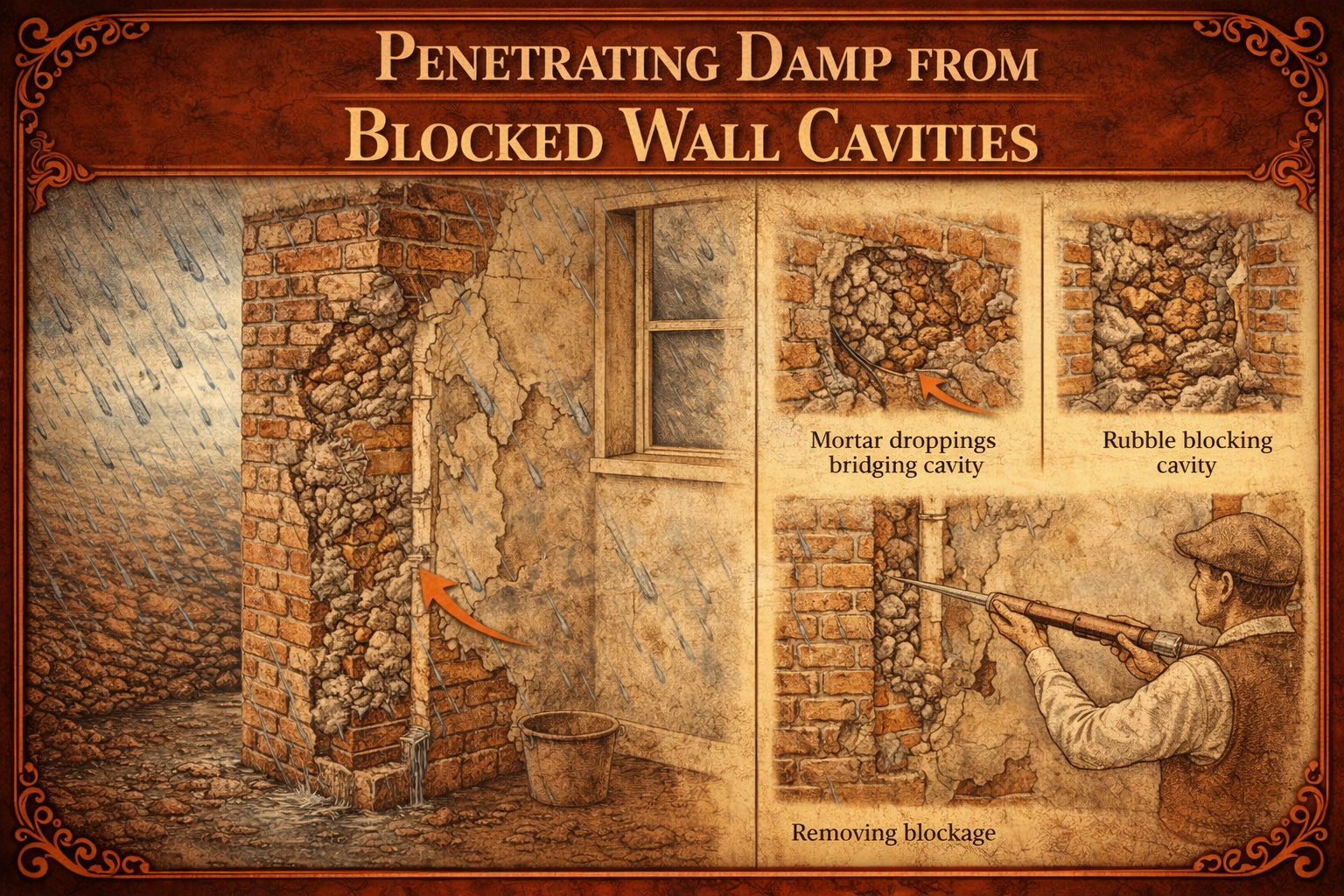
Wall cavities play a crucial role in protecting a building from moisture ingress. They are designed to act as a drainage space, allowing any water that penetrates the outer leaf of masonry to run down and exit safely without reaching the inner wall. However, when these cavities become blocked, this protective function can fail, leading to penetrating damp.
Blocked cavities can occur for several reasons. During construction, mortar droppings can fall into the cavity and accumulate over time, creating a bridge between the outer and inner walls. Retrofitted cavity wall insulation can also slump or become dislodged, causing obstructions. In some cases, external debris or even vegetation can find its way into the cavity and contribute to blockages.
When a cavity becomes blocked, water that would normally drain away can build up and transfer across to the inner wall. This creates a direct pathway for moisture to enter the property, resulting in damp patches internally.
Internally, this type of damp often appears as persistent patches on external walls, sometimes with no obvious external defect. The damp may worsen during periods of heavy rain and remain even during dry conditions due to trapped moisture within the wall structure. In some cases, salts may appear on the surface of the plaster, and finishes such as paint or wallpaper may begin to deteriorate.
Diagnosing blocked cavities can be difficult because the problem is hidden within the wall. A professional survey is usually required, often involving the use of a borescope to inspect inside the cavity.
Fixing the issue typically involves removing the obstruction. This may require drilling access points into the wall and using specialist equipment to clear debris. In more severe cases, sections of the wall may need to be opened up to fully resolve the problem.
Preventing blocked cavities involves good construction practices and ensuring that any retrofit work, such as insulation installation, is carried out correctly. Regular inspection of external walls can also help identify potential issues before they develop into serious damp problems.
Leave a Reply