
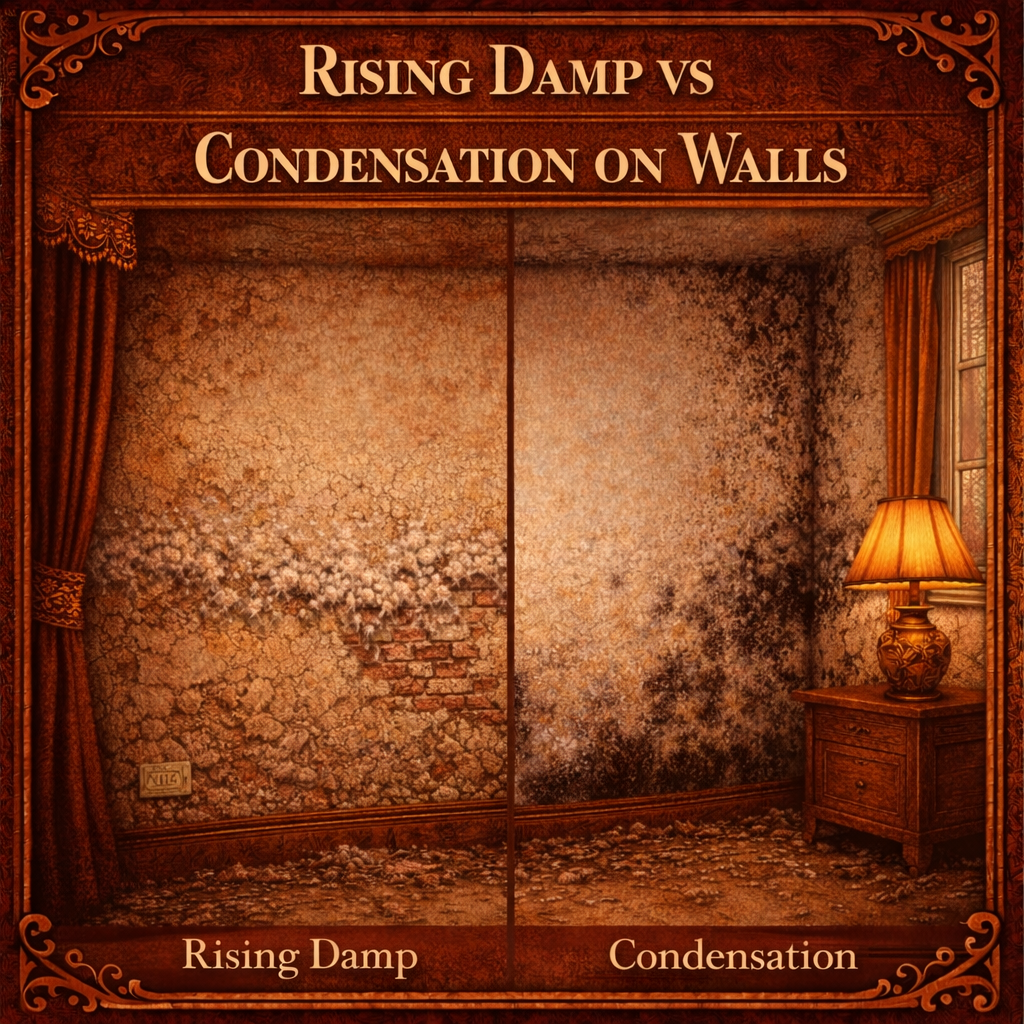
Rising damp and condensation are two of the most commonly confused causes of dampness in buildings. While they can produce similar visible symptoms, their causes and solutions are very different. Correctly identifying the issue is essential to avoid unnecessary or ineffective repairs.
Rising damp is caused by moisture travelling upward from the ground through masonry. It typically affects the lower portion of walls and is associated with a failed or missing damp proof course (DPC). In contrast, condensation occurs when warm, moist air comes into contact with a cold surface, causing water droplets to form.
One of the key differences is location. Rising damp is almost always found at low level, usually up to around one metre high. It often presents as tide marks, salt deposits, and deteriorating plaster. Condensation, on the other hand, can occur anywhere but is most common on cold surfaces such as windows, corners, and poorly ventilated areas.
Another important distinction is the presence of salts. Rising damp brings salts from the ground into the wall, which can leave behind white deposits and cause plaster to break down. Condensation does not introduce these salts, so while it may cause mould growth, it does not typically lead to the same type of plaster damage.
Mould is actually a strong indicator of condensation rather than rising damp. Black mould often forms in areas with poor ventilation, such as behind furniture or in bathrooms and kitchens. Rising damp rarely produces this type of mould.
The pattern of dampness can also provide clues. Rising damp tends to form a consistent horizontal band along the base of a wall. Condensation is more irregular and often appears in patches or droplets.
Misdiagnosis is common, and this can lead to inappropriate treatments. For example, installing a damp proof course will not solve a condensation problem, while improving ventilation alone will not stop rising damp.
In some cases, both issues may be present at the same time, particularly in poorly ventilated properties with existing damp problems. This can make diagnosis more challenging.
A thorough inspection is often required to determine the true cause. This may include checking for salt contamination, measuring moisture levels, and assessing ventilation and heating conditions.
In summary, while rising damp and condensation may appear similar, they have distinct causes and characteristics. Understanding these differences is key to applying the correct solution and avoiding unnecessary expense.
Leave a Reply