
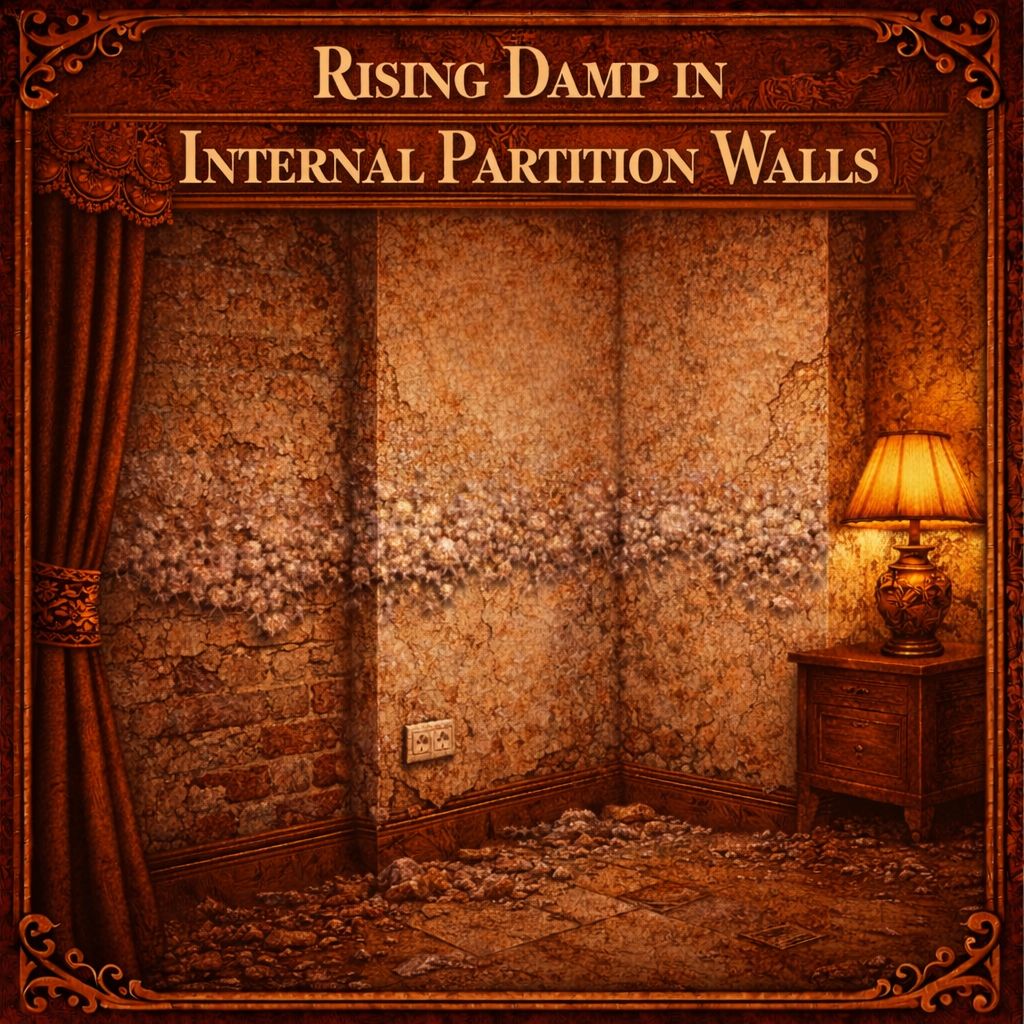
Rising damp is often associated with external walls, but it can also affect internal partition walls. This can be confusing for homeowners, as internal walls are not directly exposed to external weather conditions. However, moisture can still rise through these walls under the right conditions.
Internal partition walls are typically built off the same foundations as external walls, meaning they can absorb moisture from the ground in a similar way. If there is no effective damp proof course (DPC), or if it has failed, moisture can travel upward through the masonry via capillary action.
In some cases, internal walls may not have a DPC installed at all, particularly in older properties. Even where one exists, it can become bridged by high floor levels, screeds, or plaster that extends below the DPC line.
Signs of rising damp in internal walls are similar to those found on external walls. These include damp patches at low level, peeling paint, salt deposits, and deteriorating plaster. Because internal walls are often surrounded by warmer air, moisture can sometimes be less visible but still cause ongoing damage.
One key indicator is damage appearing on both sides of the same wall. This suggests that the moisture source is within the wall itself rather than coming from an isolated external issue.
Another factor to consider is modern flooring. Solid floors, concrete screeds, or impermeable floor finishes can trap moisture and force it into adjacent walls. This can increase the likelihood of rising damp affecting internal partitions.
Correct diagnosis is essential. Internal rising damp can sometimes be mistaken for condensation or plumbing leaks. However, the presence of salts and consistent low-level dampness usually points to moisture rising from the ground.
Treatment follows the same principles as for external walls. A damp proof course may need to be installed or repaired, often using chemical injection methods. Any bridging issues should also be addressed, such as lowering floor levels or removing plaster that extends below the DPC.
Damaged plaster should be removed and replaced with a salt-resistant system. As with other forms of rising damp, simply covering the problem will not provide a lasting solution.
In summary, internal partition walls are not immune to rising damp. Understanding how moisture can affect these walls is key to identifying and resolving the issue before significant damage occurs.
Leave a Reply