
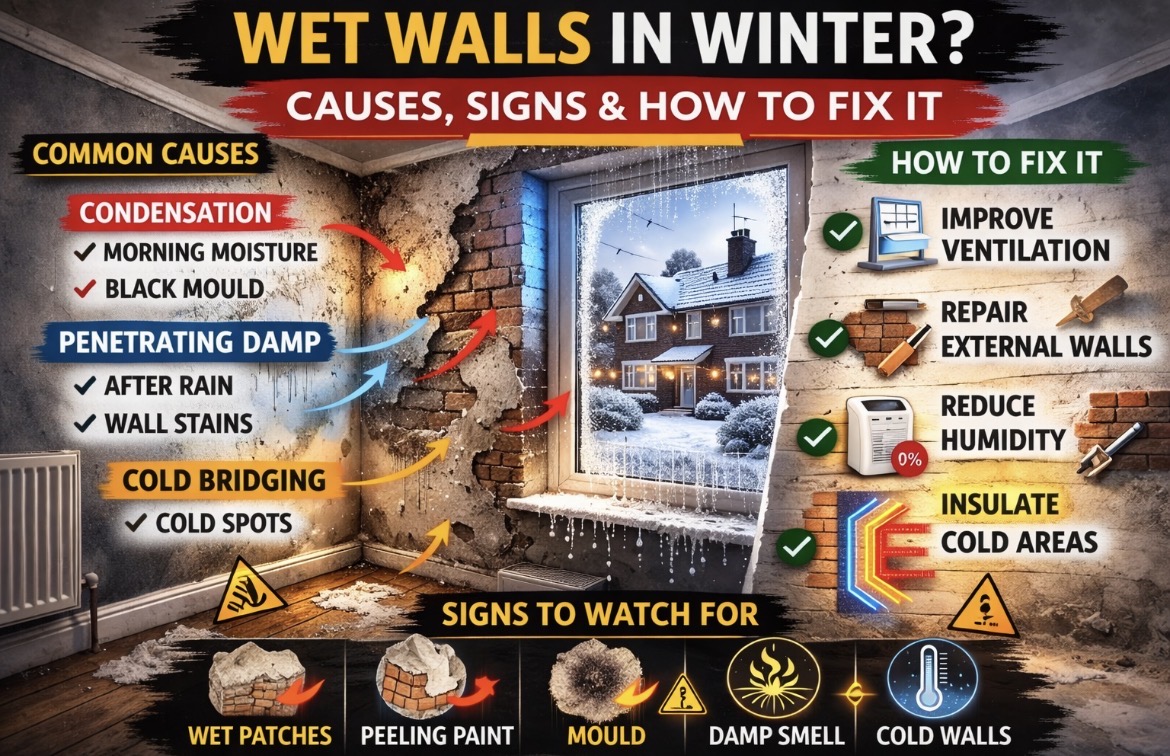
If your walls feel wet or cold during winter, it can be difficult to know whether you’re dealing with condensation, penetrating damp, or something more serious.
Winter increases moisture problems in many UK homes due to colder surfaces, reduced ventilation, and higher indoor humidity.
This guide explains why walls become wet in winter and how to identify the real cause.
Why Do Walls Feel Wet in Cold Weather?
In winter:
- Outdoor temperatures drop
- Walls become colder
- Indoor air contains moisture from cooking, showering and breathing
- Warm air meets cold surfaces
When warm, moist air touches a cold wall, condensation forms.
But condensation isn’t the only possibility.
Cause 1: Condensation (Most Common)
Signs it’s condensation:
- Appears in mornings
- Worse after showers or cooking
- Found on north-facing walls
- Black mould in corners
- Water droplets on windows
Condensation is a surface moisture issue.
It does not usually cause tide marks or salt deposits.
Cause 2: Penetrating Damp
Winter storms can drive rain into:
- Cracked brickwork
- Faulty pointing
- Defective render
- Roof junctions
Signs:
- Damp patches worsen after rain
- Localised staining
- Peeling paint
- Damp higher up on walls
If the problem appears after heavy rain, it’s unlikely to be simple condensation.
Cause 3: Cold Bridging
Cold bridging happens where insulation is weak or missing.
Common areas:
- Around window reveals
- Wall corners
- Steel lintels
- Concrete beams
These spots become colder than surrounding walls, attracting condensation repeatedly.
How to Tell Which Problem You Have
Ask yourself:
- Does it worsen after rain? → Likely penetrating damp
- Is it worse in the morning? → Likely condensation
- Is it only in winter? → Likely condensation or cold bridging
- Is it at ground level with tide marks? → Possibly rising damp
Patterns tell you more than the damp patch itself.
How to Fix Wet Walls in Winter
If Condensation:
- Increase ventilation
- Use extractor fans
- Open trickle vents
- Keep steady heating
- Avoid drying clothes indoors
If Penetrating Damp:
- Inspect gutters
- Repair cracks
- Repoint brickwork
- Check roof tiles
If Cold Bridging:
- Improve insulation
- Use thermal lining paper
- Upgrade glazing
Should You Be Concerned?
Occasional winter condensation is common.
But persistent damp can lead to:
- Mould growth
- Plaster damage
- Timber decay
If the issue continues outside winter, a professional inspection may be sensible.
Leave a Reply