
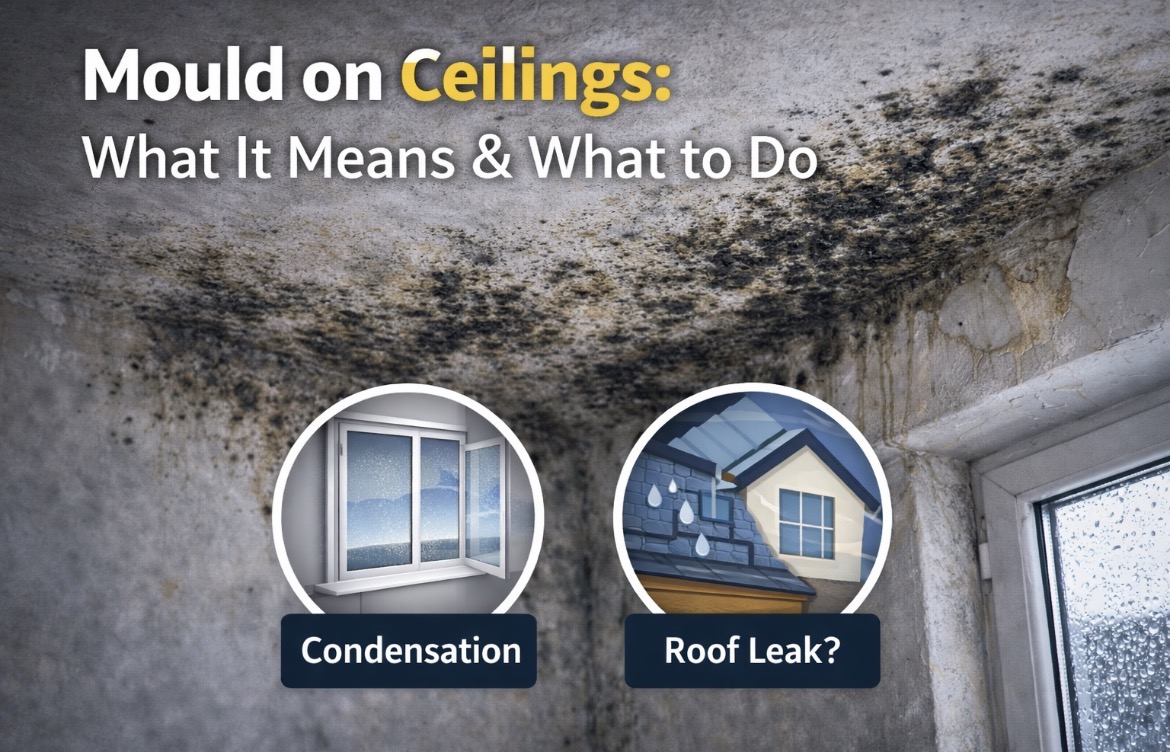
Mould on ceilings is a common but worrying problem for homeowners. It often appears as black or dark patches in corners, above windows, or across the centre of a ceiling.
While some cases are caused by condensation, ceiling mould can sometimes indicate a more serious issue such as a roof leak or poor insulation.
Understanding the pattern helps identify the cause.
Why Does Mould Grow on Ceilings?
Mould grows when moisture settles on a surface and remains damp.
Ceilings can become damp due to:
- Condensation rising from below
- Poor ventilation
- Warm air collecting at ceiling level
- Roof leaks
- Bathroom steam without extractor fans
- Poor loft insulation
Because warm air rises, ceilings are naturally vulnerable to moisture build-up.
Condensation vs Roof Leak: How to Tell the Difference
Likely Condensation If:
- Mould appears in corners
- It forms where walls meet the ceiling
- It worsens in winter
- It is present in multiple rooms
- There is no visible staining
Possible Roof Leak If:
- Mould is in one concentrated patch
- There is yellow or brown water staining
- Paint is bubbling
- The problem worsens after heavy rain
- There is damp insulation in the loft
A leak usually creates a defined damp patch, while condensation spreads more evenly.
Is Ceiling Mould Dangerous?
Small amounts are unlikely to cause serious health issues, but long-term exposure may contribute to:
- Respiratory irritation
- Asthma flare-ups
- Allergies
Because mould spores spread through the air, ceiling mould should not be ignored.
How to Remove Mould from Ceilings
For small areas:
- Wear gloves and a mask
- Use a mould remover or vinegar solution
- Avoid dry scrubbing
- Wipe gently
- Allow the area to dry fully
If mould covers a large area, professional assessment may be safer.
How to Prevent Ceiling Mould
Improve Ventilation
Install or use extractor fans in kitchens and bathrooms.
Reduce Indoor Humidity
Avoid drying clothes indoors.
Maintain Consistent Heating
Cold ceilings attract condensation.
Check Loft Insulation
Poor insulation makes ceilings colder.
Inspect the Roof
If mould is concentrated, check for missing tiles or leaks.
When to Seek Professional Help
If mould keeps returning despite improved ventilation, or if there are signs of water damage, further investigation may be required.
Persistent ceiling mould may indicate structural moisture issues.
Final Thoughts
Mould on ceilings is often caused by condensation but can sometimes signal a roof leak or insulation problem. Identifying the pattern and source of moisture is the key to solving it permanently.
Address the cause, not just the surface mould.
Leave a Reply