
Damp patches on internal walls are one of the most common concerns for UK homeowners. But before assuming the worst, it’s important to understand that not all damp is rising damp.
In many cases, what appears to be rising damp is actually condensation — and the correct diagnosis makes a significant difference to both cost and repair approach.
Understanding the difference prevents unnecessary treatment and expense.
What Is Rising Damp?
Rising damp occurs when groundwater travels upward through masonry via capillary action. It typically affects ground-floor walls and is limited by gravity.
True rising damp is less common than many homeowners believe, but it does occur — particularly in older properties.
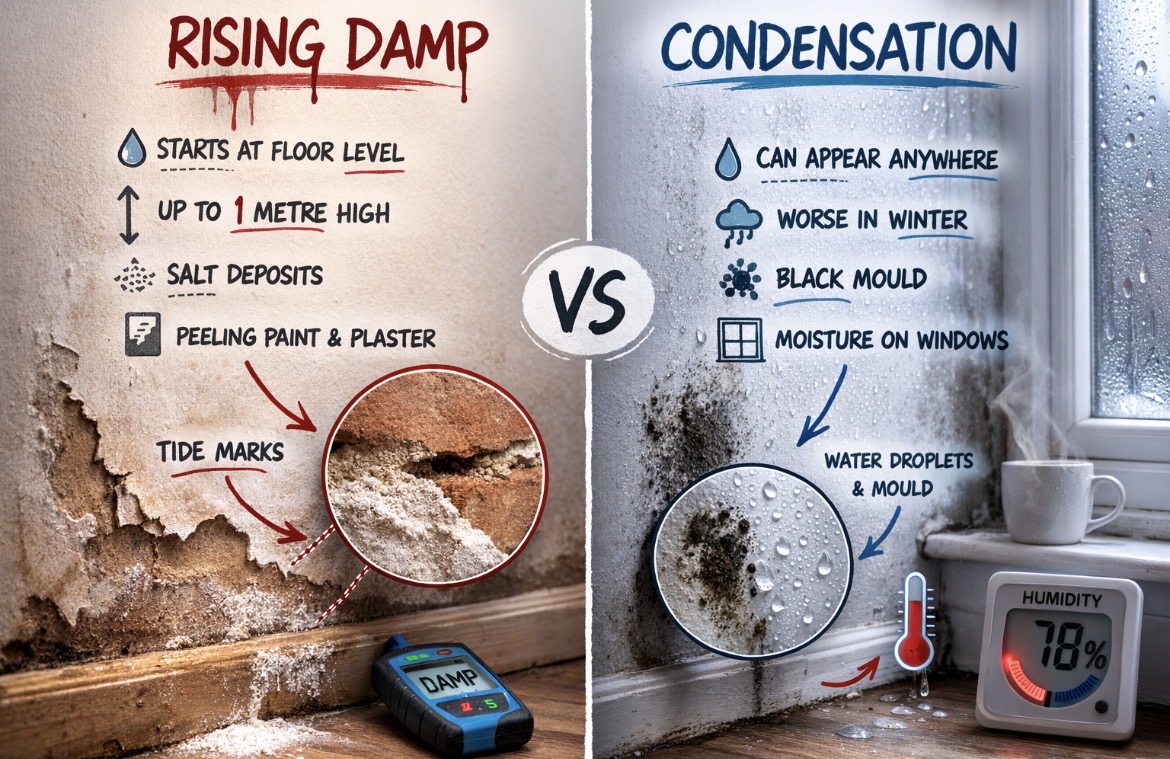
Typical signs of rising damp:
- Damp patches starting at floor level
- “Tide marks” up to around 1 metre high
- Salt deposits on plaster (white powdery residue)
- Peeling paint or bubbling plaster
- Skirting boards rotting or decaying
It usually appears on external walls and is consistent along the base of the wall.
What Is Condensation?
Condensation forms when warm, moisture-laden air meets a cold surface. It is extremely common in UK homes, especially during colder months.
Modern living habits — showers, cooking, drying clothes indoors — all increase internal humidity.
Typical signs of condensation:
- Black mould spots (especially in corners)
- Damp patches higher up walls
- Moisture on windows in the morning
- Problems worse in winter
- Mould behind furniture or wardrobes
Condensation is often worse in poorly ventilated rooms such as bedrooms, bathrooms and kitchens.
Key Differences at a Glance
Location
- Rising damp starts at the base of walls
- Condensation can appear anywhere cold surfaces exist
Height
- Rising damp rarely rises above 1 metre
- Condensation can affect upper walls and ceilings
Seasonality
- Rising damp is consistent year-round
- Condensation worsens in colder months
Mould Type
- Rising damp produces salt deposits
- Condensation produces black mould
Why Rising Damp Is Often Misdiagnosed
Many damp issues are labelled as rising damp without proper investigation.
Common alternative causes include:
- Bridged damp proof course
- High external ground levels
- Leaking gutters
- Blocked air bricks
- Poor ventilation
Chemical damp proof injections are sometimes recommended when the underlying issue is actually ventilation-related.
Accurate diagnosis is critical before any invasive work is carried out.
How Is Rising Damp Properly Diagnosed?
Professional assessment may involve:
- Moisture meter readings
- Salt analysis of plaster
- Checking the damp proof course externally
- Inspecting external ground levels
It should not rely solely on visual inspection.
How Are They Treated?
- Repair or install damp proof course
- Remove contaminated plaster
- Replaster with salt-resistant render
- Address external ground levels
Condensation Treatment
- Improve ventilation (trickle vents, extractor fans)
- Increase heating consistency
- Reduce internal moisture production
- Consider dehumidifiers
Condensation solutions are usually far less invasive and less expensive.
When Should You Be Concerned?
You should seek further investigation if:
- Damp consistently rises from floor level
- Skirting boards are deteriorating
- Tide marks are visible
- Damp persists despite improved ventilation
Early assessment prevents unnecessary treatments.
Final Thoughts
Damp can look alarming, but understanding the cause is essential before committing to costly repairs.
In the UK, condensation is statistically far more common than true rising damp.
The key is identifying the pattern.
Correct diagnosis leads to practical, cost-effective solutions — not guesswork.
Leave a Reply