
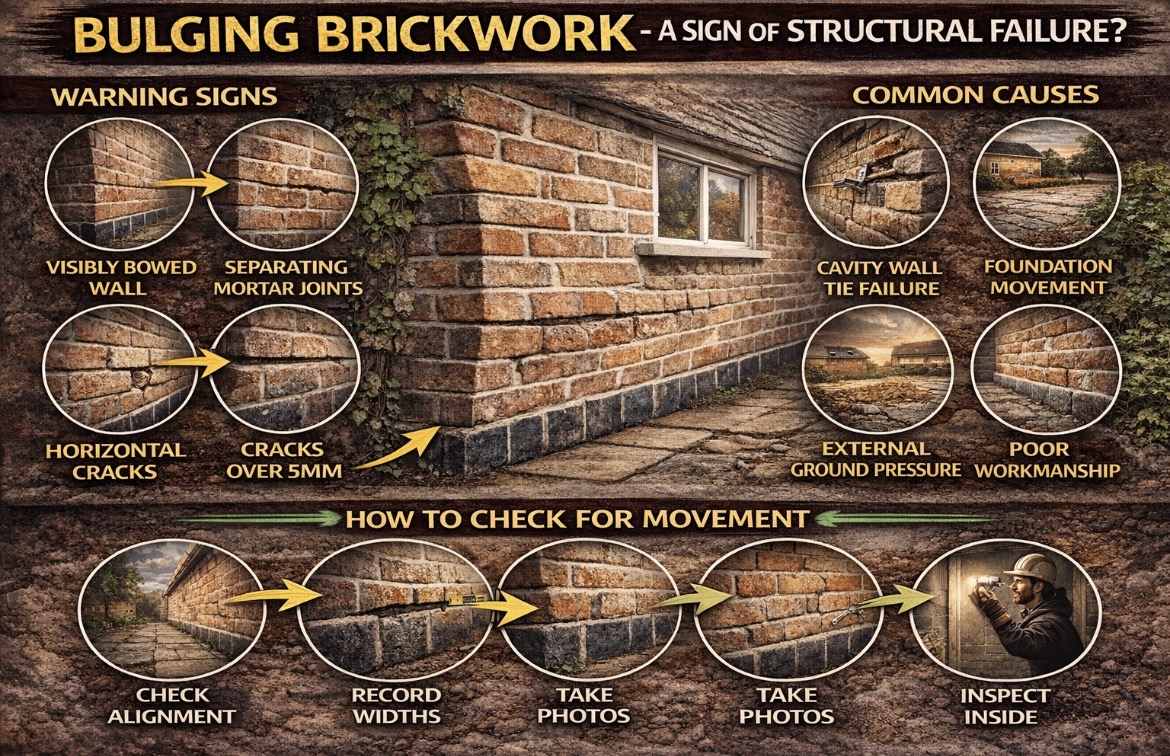
Bulging brickwork is one of the more serious external wall defects that homeowners may notice. Unlike minor surface cracks, bulging or bowing brickwork can indicate structural stress within a wall. While some cases are minor and caused by localised defects, others may signal underlying issues such as wall tie failure or foundation movement.
Identifying the cause early is essential before repairs are carried out.
What Does Bulging Brickwork Look Like?
Bulging brickwork may:
- Appear as an outward curve in the wall
- Cause mortar joints to separate
- Be accompanied by horizontal cracking
- Be most visible in long, uninterrupted walls
- Occur at mid-wall height or near DPC level
In some cases, the wall may feel unstable or visibly out of alignment when viewed along its length.
Common Causes of Bulging Brickwork
1. Cavity Wall Tie Failure
In cavity walls, metal wall ties connect the outer and inner leaf. If these ties corrode, they expand and push the outer brickwork outward, causing horizontal cracking and bulging.
2. Foundation Movement
Uneven settlement or ground movement can create stress within the wall, leading to outward displacement.
3. External Ground Pressure
Raised ground levels or heavy paving pressing against the wall can increase lateral pressure.
4. Poor Workmanship
Inadequate tying, weak mortar, or improper construction can result in long-term instability.
When Is Bulging Brickwork Serious?
Bulging brickwork should always be taken seriously, particularly if:
- The wall is visibly bowed outward
- Horizontal cracks are present
- Cracks exceed 5mm
- Mortar joints are separating
- The wall appears unstable
- Movement is progressing over time
Unlike cosmetic cracking, outward movement of masonry can present structural risk.
How to Check for Movement
- View the wall from an angle to spot curvature.
- Use a straight edge or string line to check alignment.
- Measure and record crack widths.
- Photograph the area every few months.
- Check internally for corresponding cracks.
If movement is active or worsening, professional assessment may be required.
Can Bulging Brickwork Be Repaired?
The repair depends on the cause:
- Wall tie failure may require wall tie replacement.
- Foundation movement may require structural repair.
- Minor mortar issues may be resolved with repointing.
Superficial repair without identifying the cause can allow the problem to continue.
Final Thoughts
Bulging brickwork is more serious than most surface cracks and should not be ignored. While some cases are linked to minor defects, outward movement of masonry can indicate structural stress within the wall. Early identification and proper diagnosis ensure that the correct repair method is applied and prevent further damage.
Addressing the cause — not just the visible symptoms — is essential.
Leave a Reply