
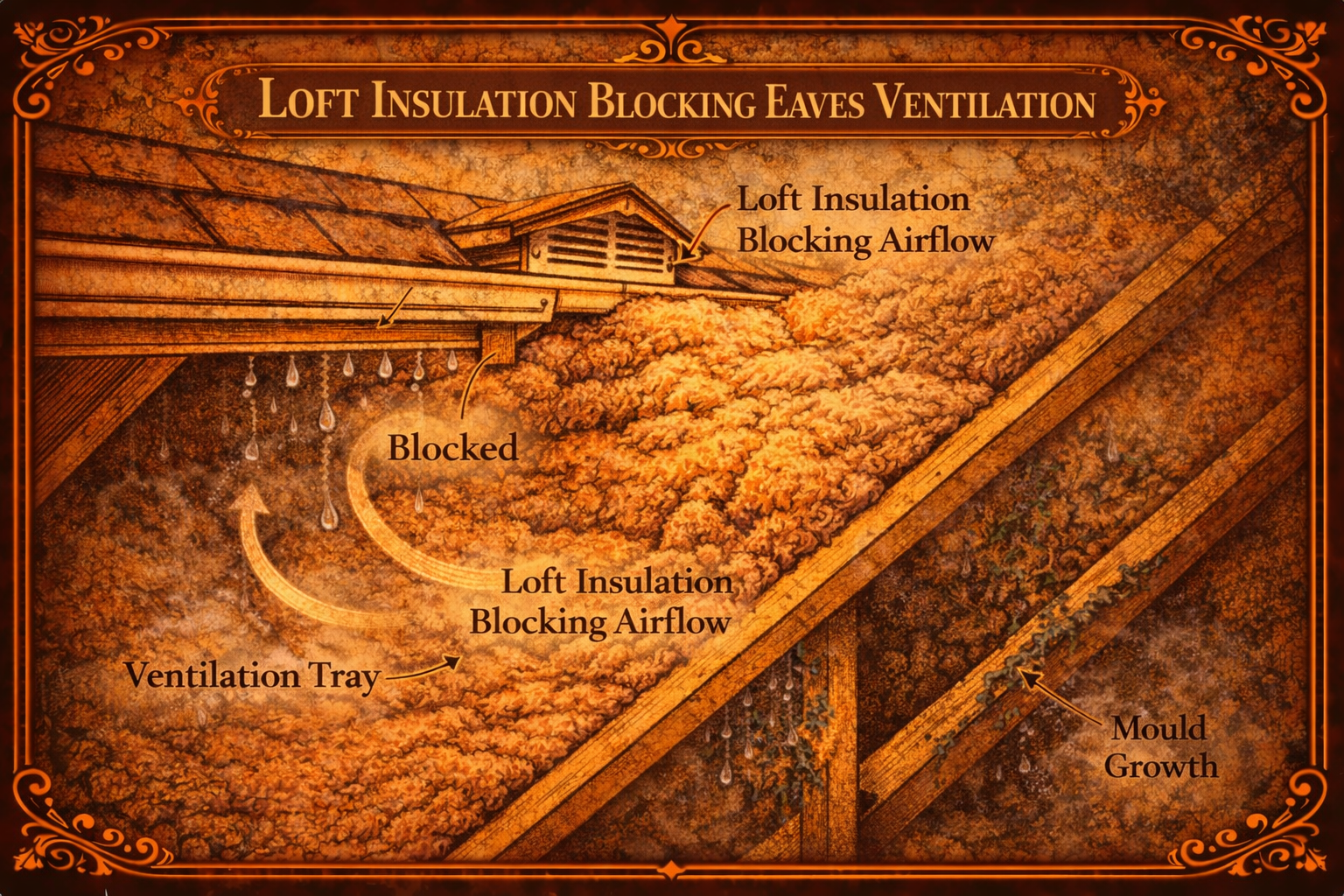
Loft insulation plays an important role in improving a home’s energy efficiency by reducing heat loss through the roof. However, when insulation is installed incorrectly, it can block essential ventilation pathways at the eaves, leading to condensation and damp problems within the loft space.
Eaves ventilation is designed to allow fresh air to enter the loft at the lowest point of the roof. This airflow helps push moist air out through higher-level vents, creating continuous air circulation that prevents moisture from building up. When insulation is pushed tightly into the eaves, it can block this airflow and trap moist air within the loft.
This issue commonly occurs when homeowners add extra insulation to improve energy efficiency without considering ventilation requirements. Insulation rolls or loose-fill insulation may be pushed all the way to the roof edges, covering soffit vents or air gaps that are intended to allow airflow.
When ventilation becomes blocked, warm, moisture-laden air from the home can accumulate in the loft space. As temperatures drop, this moisture condenses on cold surfaces such as roof felt, rafters, and nails. Over time this can lead to damp insulation, mould growth, and potential damage to roof timbers.
Typical signs of blocked eaves ventilation include water droplets on roof felt, black mould on timber surfaces, or damp patches appearing in the loft during cold weather. In some cases, condensation may drip down onto insulation or ceiling plasterboards below.
Fortunately, this issue is usually straightforward to resolve. Insulation should be carefully pulled back from the eaves area to create a clear airflow pathway. Ventilation trays or rafter trays can also be installed to maintain a gap between the insulation and the roof covering, ensuring air can flow freely.
Soffit vents should also be checked to ensure they are not blocked by insulation, debris, or paint. Keeping these vents clear allows fresh air to enter the loft space and helps restore proper ventilation.
Balancing insulation and ventilation is essential for maintaining a healthy loft environment. While good insulation improves energy efficiency, proper ventilation prevents moisture problems that could otherwise damage the roof structure and reduce the effectiveness of the insulation itself.
Leave a Reply