
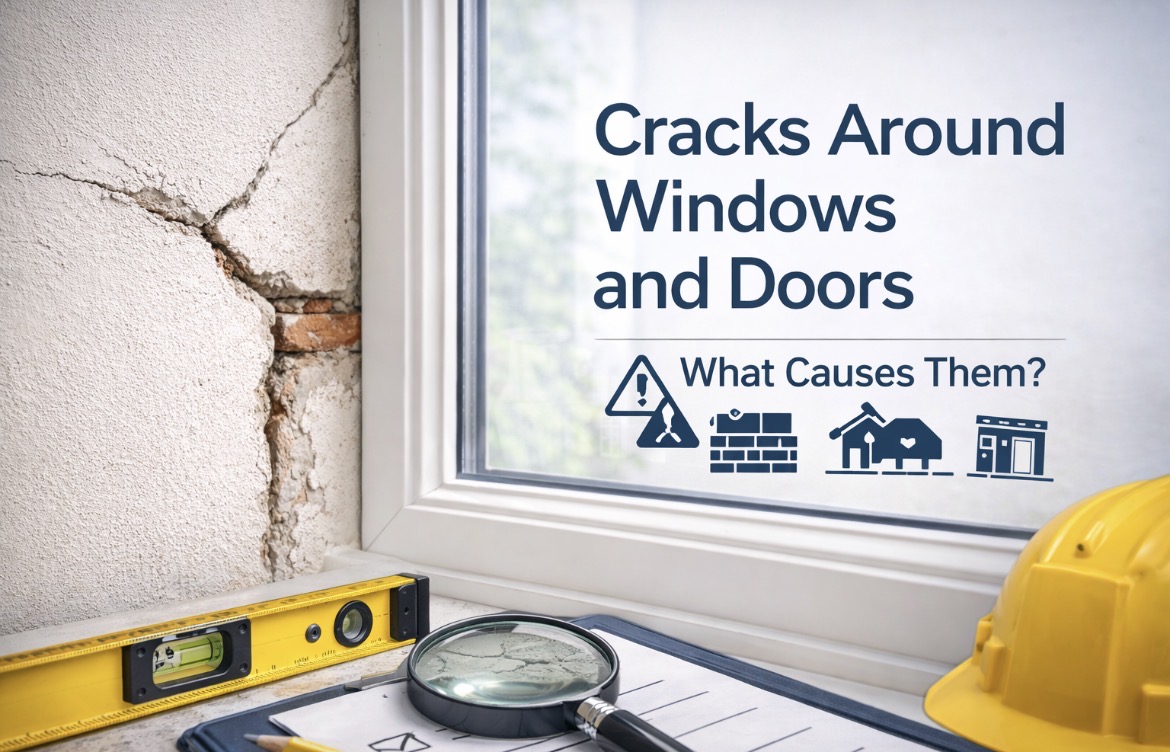
Cracks around windows and doors are common in homes of all ages. While many are harmless and caused by minor settlement or plaster shrinkage, others may indicate structural movement or lintel failure. The location, size and pattern of the crack help determine whether it is cosmetic or a sign of a deeper issue.
Understanding the cause before repairing the surface is essential.
Why Do Cracks Appear Around Openings?
Windows and doors create natural weak points in walls. The masonry above relies on a lintel to support the load, and any movement or stress tends to show first at the corners of these openings.
Cracks often form:
- Diagonally from the top corners
- Vertically along the frame edge
- Horizontally across the lintel line
- Internally and externally in the same area
Common Causes of Cracks Around Windows and Doors
1. Normal Settlement
As buildings settle, slight movement can cause minor cracking at the weakest points — usually corners of openings.
2. Lintel Failure
A failing or undersized lintel can cause brickwork above the opening to drop slightly, leading to diagonal or stepped cracks.
3. Thermal Movement
Materials expand and contract with temperature changes, sometimes causing straight-line cracks around frames.
4. Cavity Wall Tie Failure
Corroded wall ties can create horizontal pressure in masonry, leading to cracking near window lines.
5. Subsidence
If foundations shift, diagonal cracks often appear from the corners of doors and windows.
When Are Cracks Around Openings Serious?
You should monitor cracks carefully if they:
- Are wider than 3–5mm
- Continue to widen
- Appear both inside and outside
- Form a stair-step pattern in brickwork
- Cause frames to twist or doors/windows to stick
- Are accompanied by bulging brickwork
Cracks that widen at one end may suggest ongoing movement.
Cosmetic vs Structural Cracks Around Windows
Cosmetic cracks:
- Thin hairline cracks in plaster
- Do not worsen over time
- Limited to decoration layer
Structural cracks:
- Extend through brickwork
- Follow mortar joints
- Reappear after repair
- Increase in width
Monitoring over several months helps determine if movement is active.
How to Check for Ongoing Movement
- Measure the width of the crack.
- Mark the end points with pencil and date them.
- Take photographs every 2–3 months.
- Check if doors or windows begin sticking.
- Inspect the same area externally.
If cracks widen or multiple cracks appear nearby, further assessment may be required.
Final Thoughts
Cracks around windows and doors are often harmless settlement cracks, but they can also indicate lintel failure or structural movement. Identifying the pattern, width and progression of the crack is the first step in deciding whether simple cosmetic repair is sufficient or whether professional investigation is needed.
Addressing the cause — not just the crack — prevents recurring issues.
Leave a Reply